Grid-Tied (On-Grid) or Hybrid Solar Power System?
An honest engineering breakdown for Moldova: Anti-Islanding protection, LiFePO4 battery lifespan, and the real difference in payback periods — free of marketing promises of "free electricity forever".
Block 1. Net Billing, Tariffs, and the Realities of Moldovan Grids
Since January 1, 2024, Moldova has operated under Facturare netă (Net Billing) — accounting in money, not in kilowatt-hours. This directly determines which system pays off faster: one that sells everything to the grid, or one that maximizes self-consumption.
How Net Billing Works
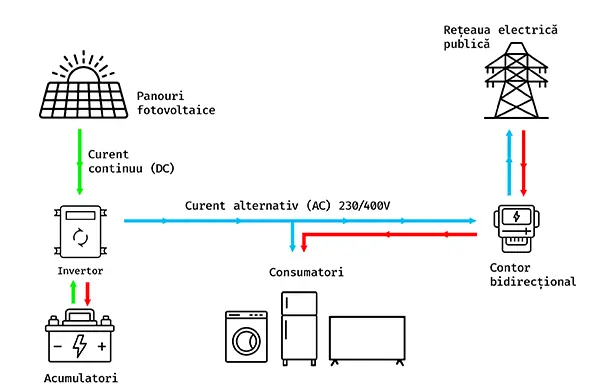
During the day, when generation exceeds household consumption, the surplus flows into the grid and is recorded by a bidirectional meter. The supplier (Premier Energy / FEE Nord) credits this volume in money — at a price that is always lower than the retail tariff. At night and in winter, you purchase electricity from the grid at the full retail tariff, and the accumulated monetary balance is deducted automatically.
The settlement period is the calendar year, from January 1 to December 31. If a positive monetary balance remains in the personal account by December 31, upon written request the supplier is required to transfer it to the prosumer's bank account, or the balance rolls over as an advance credit for the following year. This is not a "kilowatt-hour balance" as was previously the case under Net Metering (Contorizare netă), but specifically monetary clearing — and this is the fundamental distinction that many customers only understand upon receiving their first bill.
There is also a less obvious caveat: the actual volume-weighted average buyback price for the current month is known to the supplier only after all wholesale market transactions for that month have cleared. Consequently, exported energy is often monetized only on the subsequent invoice, with a one-period settlement lag.
If the total installed inverter capacity exceeds the connection point limit agreed in the Technical Specifications (TU), Premier Energy does not purchase the surplus in full, but applies a reduction coefficient:
Energy generated in excess of this quota is written off without monetization — yet another reason not to oversize system capacity beyond the approved connection limit.
The solar system powers the house directly; surplus flows to the grid → recorded by the meter → converted into monetary credit at the ANRE wholesale price
The house draws power from the grid at full retail tariff → invoice balance is offset against accumulated monetary credit
Surplus buyback is priced significantly lower than the retail tariff — therefore, the higher the share of energy consumed directly on site (self-consumption), the greater the real savings. Selling "indiscriminately" to the grid is nearly half as profitable as consuming it on site.
Current Tariff Schedule (ANRE Decision No. 222 of 31.03.2026)
| Connection Point | Base Tariff, MDL/kWh | Day (07:00–23:00) | Night (23:00–07:00) |
|---|---|---|---|
| High Voltage (35; 110 kV) | 2.84 MDL/kWh | 3.03 MDL/kWh | 2.22 MDL/kWh |
| Medium Voltage (6; 10 kV) | 3.03 MDL/kWh | 3.22 MDL/kWh | 2.41 MDL/kWh |
| Low Voltage (0.4 kV) — Private home, office, small manufacturing Main Tariff | 3.56 MDL/kWh | 3.75 MDL/kWh | 2.94 MDL/kWh |
Excluding VAT. Time-of-use tariffs apply only in the presence of an interval meter. Source: ANRE Decision No. 222 of 31.03.2026, Monitorul Oficial No. 146-147 of 02.04.2026.
Decisions No. 222/223 regulate the retail tariff for purchasing electricity from Premier Energy — but not the price at which the company buys back surplus energy from prosumers. That is a distinct metric established not by ANRE decree, but by Art. 39² para. (2) of Law No. 10/2016: the supplier is obligated to buy back surplus electricity monthly at the volume-weighted average wholesale purchase price — the pure cost of energy (Energocom, OPCOM imports, local generation) excluding distribution fees and supplier margins that comprise the retail tariff. According to Premier Energy's official registry, throughout 2026 the price fluctuated between 2.30 (April) and 3.13 MDL/kWh (September), averaging 2.73 MDL/kWh over January–September. This is the baseline figure applied in our calculations below.
Why Rural and Suburban Grids Struggle with Grid-Tied Systems
Most 0.4 kV lines in the suburbs of Chisinau (Durlești, Trușeni, Stăuceni, Colonița) and rural villages were originally engineered for loads of 2–3 kW per household. When several houses on a single dead-end feeder install 10 kW grid-tied inverters simultaneously, midday line voltage can spike above 253 V — the upper threshold of standard EN 50549-1. Consequently, inverters trip on overvoltage faults en masse, forfeiting peak solar generation hours.
In winter, the inverse issue arises: as heating appliances turn on, voltage at remote sections of the line drops to 170–190 V. Uneven phase loading leads to phase imbalance — 185 V on one phase, 258 V on an adjacent one. Under these conditions, a three-phase inverter trips offline entirely when any single phase strays out of regulatory tolerance.
Solar Insolation and Seasonality in Moldova
Annual generation per 1 kW of installed capacity (tilt angle 32–35°, south orientation):
The ratio of summer (July) to winter (December) generation ranges from 5.5:1 to 7:1. A 10 kW system yields a modest 250–320 kWh per month in winter compared to 1 600–1 750 kWh in July — making year-round home heating relying solely on solar energy physically impossible without natural gas or pellet backup.
Block 2. Anti-Islanding Protection: Why Panels Shut Down Along with the Grid
"Bright sunshine outside, 10 kW of panels on the roof, yet the house is dark — because Premier Energy disconnected the line." This is neither equipment failure nor a defect: it is a mandatory safety mechanism integrated into every certified grid-tied inverter.
The Physics of Anti-Islanding Protection
A grid-tied inverter operates as a grid-following current source: it does not create its own voltage sine wave. Instead, it reads the frequency and voltage of the external utility grid and injects current synchronously in phase with it. When the grid goes down, the inverter literally has no reference signal to follow.
Under standards EN 50549-1 / IEC 62116, the inverter must physically disconnect its power relays within 100–200 ms of a grid outage, fully de-energizing its AC circuit. If the inverter continued feeding power, it would create an energized "island" on the utility line, posing fatal hazards to linemen repairing faults and risking uncontrolled voltage and frequency deviations.
Architectural Difference: Grid-Tied vs. Hybrid
A single AC terminal connected in parallel to the main breaker. When the utility grid fails, the Anti-Islanding relay opens — de-energizing the entire home, including the solar system itself.
Two physically distinct AC terminals: Grid and Backup/Load. Upon grid failure, the Grid port is isolated while the Backup port remains continuously powered by the panels and battery — the inverter generates a clean 230/400 V, 50 Hz sine wave independently.
UPS Transfer Speed
Modern hybrid inverters (Deye, Solis, Victron) transfer to backup power within 4–10 ms (entry-level units up to 20 ms). Standard PC power supplies built to the ATX specification maintain internal rail voltages for at least 16–17 ms (hold-up time). The switchover occurs seamlessly without restarting computers, routers, or servers. High-quality sine waves (THD < 2–3%) also protect phase-sensitive electronics in gas boilers.
Certain hybrid inverters (such as Deye SG04LP3) can technically supply power to the backup port during daylight hours without a battery. However, this is an unstable fallback demonstration, not a reliable operating mode: without a battery buffer, power balance must be maintained every microsecond. A passing cloud can reduce generation by 70% in 1.5 seconds — the MPPT controller cannot react fast enough, and the inverter trips on DC Bus Under-voltage. The result is continuous reboot cycles that can destroy compressor motors in refrigerators and well pumps. Selling a battery-less hybrid as a dependable backup system is a serious engineering mistake.
Zero Export: A Mandatory Mode During Permitting
Between equipment installation and official utility commissioning (Admitere în exploatare), prosumers face a 4–12 week regulatory approval cycle. Running the system into the grid beforehand risks turning older induction meters backwards (legally treated as electricity theft). The solution: a bidirectional Smart Meter (Chint DTSU666, Eastron SDM630) communicating over RS-485 that continuously reads household consumption, prompting the inverter to adjust its MPPT operating point to maintain export at strictly 0 W. The system delivers savings from day one without legal penalties.
Peak Shaving: Overcoming Connection Capacity Limits
If expanding connection capacity with Premier Energy requires building a dedicated transformer substation (prohibitively expensive or technically unfeasible), the inverter can be programmed with a hard grid-draw ceiling — for example, 15 kW on a 25 A main breaker. When high-draw equipment turns on, the inverter supplements the required power from the solar panels and battery storage, preventing the main breaker from tripping on overload.
Block 3. LiFePO4 Batteries: Chemistry, Lifespan, and Safety
Lead-acid (AGM/GEL) and NMC lithium chemistries have been almost entirely replaced by lithium iron phosphate (LiFePO4) in stationary energy storage systems — here is why.
| Parameter | LiFePO4 (LFP) | Li-ion (NMC) | Gel / AGM |
|---|---|---|---|
| Cycles to 80% Capacity (SoH) | 6 000–8 000 | 1 500–2 500 | 400–600 |
| Depth of Discharge (DoD) | 80–90% | 80–85% | 30–50% |
| Thermal Runaway Threshold | +270…+300°C | +150…+210°C | +60…+80°C (H₂ risk) |
| Round-Trip Efficiency | 95–98% | 92–95% | 75–82% |
| Levelized Cost of Storage (LCOS), €/kWh | 0.06–0.09 | 0.18–0.25 | 0.35–0.50 |
Lifespan and Safety Comparison
The olivine crystal lattice of LiFePO₄ alters unit-cell volume by less than 6.5% during charge and discharge — compared to 10–12% in layered NMC oxides, which suffer micro-cracking and rapid degradation. Strong covalent P–O bonds remain stable under high thermal stress, preventing the release of free oxygen and making LFP the most fire-safe lithium chemistry on the market.
Low-Voltage (48 V) vs. High-Voltage (150–600 V) Batteries
Residential systems up to 10–12 kW (Deye, Pylontech US5000, Dyness). Safe touch voltage during installation, simple modular scaling, independent module operation. However, a 12 kW inverter draws discharge currents up to ≈263 A, requiring heavy 70–95 mm² cables and an internal step-up DC-DC stage that limits overall efficiency to 92–94%.
Three-phase homes above 10 kW and commercial businesses (Huawei LUNA2000, BYD HVS/HVM, Deye BOS-G). Operating current at 10 kW is only 20–25 A, accommodated by standard 4–6 mm² solar cables with 96–98% round-trip efficiency. Disadvantage: battery voltages exceed 300 V DC, presenting lethal shock hazards that require specialized installation credentials.
Temperature Operating Envelope and BMS
LiFePO4 cells must never be charged below 0°C: lithium diffusion into the graphite anode slows drastically, causing metallic lithium dendrites to plate onto the anode surface. This causes permanent capacity loss and risks internal short circuits.
Discharge only. Charging locked by BMS
Transition zone, derated charge current
Optimal window — 100% rated cycle life
Accelerated cell degradation
Practical rule for Moldovan homes: batteries must not be installed in unheated garages or outdoors, where winter temperatures plunge to −10…−15°C. Systems require an indoor utility room maintained at +10…+25°C, or premium battery modules with integrated PTC heating pads activated prior to charging.
In-depth review of LiFePO4: electrochemistry, LV vs. HV, lithium plating, BMS requirements →Block 4. Realistic Payback Calculation
Below is a financial calculation for two representative scenarios based on the current ANRE retail tariff (3.56 MDL/kWh) and Premier Energy's official 2026 average buyback price (2.73 MDL/kWh). Detailed simulations tailored to your exact load profile and system size are powered by the live calculator below, utilizing identical formulas to our Payback Calculator.
- Retail tariff: 3.56 MDL/kWh (ANRE Decision No. 222 of 31.03.2026, LV 0.4 kV, excluding VAT).
- Surplus buyback price: 2.73 MDL/kWh — weighted average across published 2026 months (Jan–Sep) from Premier Energy's Net Billing registry. Monthly figures fluctuate between 2.30 and 3.13 MDL/kWh reflecting wholesale procurement costs.
- Exchange rate: 1 EUR ≈ 19.5 MDL.
- CAPEX: Turnkey market benchmarks (hardware + installation + design + utility commissioning); final pricing varies with chosen equipment kit — see live calculator.
Case A — Private Home, 10 kW (Three-Phase)
Generation: 12 000 kWh/year · Household Consumption: 8 000 kWh/year
| Configuration | CAPEX, € | Self-Consumption | Annual Benefit, € | Payback Period |
|---|---|---|---|---|
| Pure On-Grid | 6 800 € | 35% | ≈€1 859 / year | ≈3.7 years |
| Hybrid-Ready (Without Battery) | 8 200 € | 35% | ≈€1 859 / year | ≈4.4 years |
| Full Hybrid + 10 kWh LiFePO4 Recommended | 12 200 € | 67% | ≈€2 021 / year | ≈6.0 years |
Case B — Commercial Business, 50 kW (Daytime Operations)
Generation: 60 000 kWh/year · Facility Consumption: 90 000 kWh/year
| Configuration | CAPEX, € | Self-Consumption | Annual Benefit, € | Payback Period |
|---|---|---|---|---|
| Pure On-Grid | 26 500 € | 85% | ≈€10 571 / year | ≈2.5 years |
| Hybrid-Ready (Without Battery) | 32 000 € | 85% | ≈€10 571 / year | ≈3.0 years |
| Full Hybrid + 40 kWh LiFePO4 Recommended | 46 500 € | 98% | ≈€10 903 / year | ≈4.3 years |
Adding battery storage extends the baseline payback timeline by 2–2.5 years. However, this metric completely ignores the direct financial losses caused by utility outages:
- Heat pump freeze-up at −15°C€3 000 – €8 000
- Raw material spoilage in bakery/food processing during cold room outageFrom €4 000
- Server room / clinic SLA breach during a 4-hour blackoutReputational damage
+ penalties - HoReCa banquet cancellation caused by local blackout≈€2 500 / evening
A single 6–12 hour emergency grid outage can easily erase the entire price premium of a 10–20 kWh battery. Under Moldovan grid conditions, LiFePO4 functions primarily as an insurance policy rather than an energy arbitrage tool.
Calculate Precise Metrics for Your Home or Business
Powered by the same calculation engine as our dedicated Payback Calculator — adjust the sliders for system capacity, electricity bills, and inverter topology.
1. Energy Consumption & System Specs
2. Payback & Performance Results
Please note: this estimate is a preliminary mathematical model based on average climate insolation data and current base tariffs. Actual generation and payback depend on your roof's tilt and orientation, shading, seasonal consumption and the equipment you choose. For an exact techno-economic feasibility study of your property, order an on-site engineering audit.
What assumptions does this estimate use?
- Generation
- 1 245 kWh per year for each 1 kW of panels: the PVGIS norm for Chisinau, South orientation, 35° tilt.
- Panel degradation
- Not included: figures show the first year of operation. Panels typically lose 0.5–0.7% of their output per year.
- Surplus and Net Billing
- Simplified: 85% of generation for On-Grid and 95% for Hybrid is valued at the retail tariff, capped at your annual bills. The surplus buyback price changes monthly and is not modelled separately.
- Tariff
- Uses the current tariff of 3.56 MDL/kWh, excluding VAT and any future indexation.
- System cost
- The catalogue kit price; between kits, an estimate from the neighbouring kits. Above the largest kit: 650 €/kW for On-Grid and 750 €/kW plus the battery for Hybrid. Capacity different from 16 kWh is priced at 220 €/kWh. Exchange rate: 19.50 MDL/EUR.
This estimate is for general information only, is based on standard insolation coefficients and average tariffs, and is not a public offer. Financial figures, self-consumption share and payback periods are confirmed when an individual project proposal is prepared.
 230V •
Monofazat
Kit Hybrid 10 kW + 16 kWh
Complete hardware, certified mounting, Premier Energy technical file, and commissioning.
Need an exact engineering assessment for your roof?
Send your specs to a Volt Master solar engineer. We will prepare a preliminary proposal within 24 hours and confirm the exact quote after a site visit.
Block 5. Comparison Matrix and Honest Trade-Offs
| Criterion | On-Grid | Hybrid without Battery | Full Hybrid + LFP |
|---|---|---|---|
| Utility Grid Outage Behavior | Total blackout within ≤100 ms (Anti-Islanding) | Shuts down by default; unstable daylight-only islanding without battery | Seamless transfer to backup in 4–10 ms; loads experience zero interruption |
| Line Voltage Spike Stabilization | None — trips offline when U > 253 V | None for the grid-tied port | Critical loads completely isolated from grid surges |
| Nighttime Use of Solar Energy | Impossible | Impossible without battery | Powers up to 90% of evening/nighttime consumption |
| Grid Inversion Efficiency | 97.5–98.5% | 96.5–97.5% | 95.5–97% (pass-through); 92–95% (battery round-trip) |
| Switchgear and Installation Complexity | Minimal — parallel tie-in at main breaker | Moderate — Smart Meter + backup distribution bus | High — complete main panel rebuild, subpanel load separation |
| Acoustic Noise and Footprint | Low, 15–25 kg wall footprint | Moderate, 25–35 kg wall footprint | High — 35 kg inverter + 50–100 kg per 5 kWh battery bank |
| Initial CAPEX (10 kW) | Lowest, ≈€6 800 | Moderate, ≈€8 200 | Highest, ≈€12 200 |
| Backup Generator Integration | Extremely complex, requires external ATS | Basic, requires external contactors | Dedicated GEN port, automated dry-contact auto-start |
| Peak Shaving (Contracted Capacity) | Not supported | Not supported without battery | Full support — battery power dynamically adds to grid capacity limit |
| Zero Export Capability | Requires external Smart Meter | Built-in natively via Modbus | Built-in natively, stores excess solar into battery |
| Power Hardware Service Life | 12–15 years | 10–15 years | Inverter: 10–12 years; LFP battery: 12–15 years (>6 000 cycles) |
| Payback (Moldova 2026 Benchmark) | 2.5–3.7 years | 3.0–4.4 years | 4.3–6.1 years |
Grid-Tied System (On-Grid)
Fast PaybackSystem Advantages
- Highest energy conversion efficiency
- Lowest capital cost per installed kilowatt
- Maximum reliability — minimal components, zero batteries or transfer contactors
- Fast and straightforward utility commissioning
Trade-offs and Limitations
- Completely inoperative during any utility grid outage
- Vulnerable to high line impedance — overvoltage shutdowns on overloaded rural feeders
- Value leakage on the Net Billing spread: selling cheap during the day, buying high at night
Hybrid System (Hybrid + LiFePO4)
Total Energy SecuritySystem Advantages
- Total energy security during Premier Energy / RED Nord outages
- Self-consumption up to 90% — minimizes financial losses on the Net Billing spread
- Protects sensitive electronics from grid voltage surges and phase imbalances
- Peak Shaving capability for properties with restricted grid-connection amperage
Trade-offs and Limitations
- 60–90% higher initial investment compared to a grid-tied system
- Requires a temperature-controlled indoor utility space above 0°C
- Requires electrical panel reconfiguration and separation of critical loads
Block 6. Tailoring Systems to Real-World Needs
The decision framework used by Volt Master engineers during initial technical site audits.
Residential Sector
Paying an extra €5 000–€6 000 for an inverter and battery to cover 30 minutes of outage per year cannot be financially justified.
A single winter freeze-up at −15°C costs thousands of euros in repairs — a hybrid system covers baseline household loads for 18–24 hours without a generator.
The dedicated backup bus and hybrid inverter are installed immediately — batteries can be plugged in later without rewiring.
Commercial Sector (B2B)
Solar generation aligns with operating loads by 85–90% — almost all energy is consumed directly on site, resulting in a payback under 4 years. Batteries would unnecessarily tie up working capital.
Three-tier resilience: the battery bank carries the load within 5 ms; for prolonged outages, the inverter automatically triggers generator startup.
The inverter clamps utility grid draw at the authorized 18 kW threshold, seamlessly supplying surge peaks from the solar array and battery bank.
Volt Master Pre-Installation Engineering Checklist
- Phase-neutral loop impedance measurement: If calculated line voltage exceeds 250 V under full design export, a grid-tied system will not be installed without feeder upgrades; the viable alternative is a hybrid system with export limiting.
- Load profile modeling: For clients with evening peak loads, we candidly demonstrate the Net Billing price spread — without a battery, monetary savings drop by 30–40% compared to former net metering schemes.
- Uncompromising electrical safety: LiFePO4 batteries are installed exclusively in rooms with year-round positive temperatures, equipped with DC disconnect breakers and earthing configured to TN-C-S/TT standards in strict compliance with Moldovan electrical engineering codes.
Not Sure if Your Local Feeder Can Handle a Grid-Tied System?
Leave your phone number — a Volt Master engineer will measure line impedance and advise honestly whether an On-Grid system works or if a hybrid setup with export control is required.
Frequently Asked Questions: On-Grid vs. Hybrid Systems
Engineering and regulatory answers regarding system selection, Net Billing, and battery storage.