Commercial Solar Power Systems in Moldova
Why commercial On-Grid systems pay off faster than residential setups, when battery storage is worth the investment, and how Peak Shaving overcomes contracted grid capacity limits.
Why Commercial Solar Economics Differ from Residential Homes
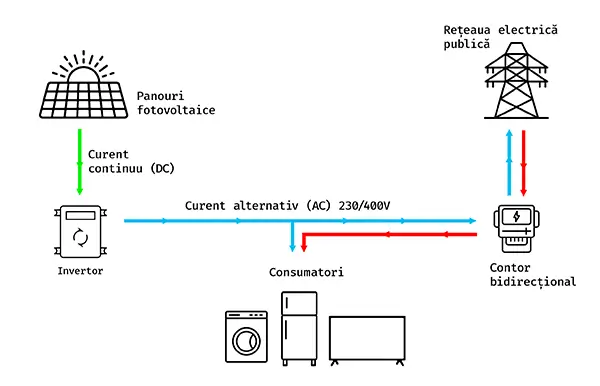
The daytime load profile of most commercial enterprises — factories, warehouses, offices, bakeries — aligns almost perfectly with the solar generation curve: peak demand runs from 08:00 to 18:00, precisely during sunlight hours. This delivers a direct on-site self-consumption rate of 85% or higher without requiring a single kilowatt-hour of battery storage — which is why commercial On-Grid systems in Moldova achieve payback 2–3 times faster than residential installations.
Case Study — Small Business, 30 kW
Generation: 36 000 kWh/year · Consumption: 54 000 kWh/year (office, small workshop, retail shop)
| Configuration | CAPEX, € | Self-Consumption | Annual Benefit, € | Payback Period |
|---|---|---|---|---|
| Pure On-Grid | 17 500 € | 85% | ≈€6 342 / year | ≈2.8 years |
| Hybrid-Ready (Without Battery) | 21 000 € | 85% | ≈€6 342 / year | ≈3.3 years |
| Full Hybrid + LiFePO4 Recommended | 31 500 € | 98% | ≈€6 542 / year | ≈4.8 years |
Case Study — Medium Business, 50 kW
Generation: 60 000 kWh/year · Consumption: 90 000 kWh/year (manufacturing facility, cold storage warehouse, bakery)
| Configuration | CAPEX, € | Self-Consumption | Annual Benefit, € | Payback Period |
|---|---|---|---|---|
| Pure On-Grid | 26 500 € | 85% | ≈€10 571 / year | ≈2.5 years |
| Hybrid-Ready (Without Battery) | 32 000 € | 85% | ≈€10 571 / year | ≈3.0 years |
| Full Hybrid + LiFePO4 Recommended | 46 500 € | 98% | ≈€10 903 / year | ≈4.3 years |
Calculations based on unified tariffs: retail 3.56 MDL/kWh (ANRE Decision No. 222), surplus buyback 2.73 MDL/kWh (weighted average Jan–Sep 2026, Premier Energy registry). Full methodologies and formulas are detailed in Block 4 of our Pillar Guide.
Peak Shaving: Resolving Contracted Grid Capacity Limits
Expanding technical connection capacity (TU) with Premier Energy often requires constructing a dedicated 10/0.4 kV transformer substation or is physically impossible due to feeder line saturation — especially in dense industrial zones.
Example: A self-service car wash or restaurant with commercial induction ovens requests 40 kW from Premier Energy, but the utility approves only 18 kW due to local grid constraints. A hybrid inverter is configured with a strict grid-import cap at the authorized 18 kW level. When heavy loads cycle on (steam combi-ovens, high-pressure pumps totaling up to 25 kW), the inverter draws the permitted 18 kW from the grid while seamlessly supplying the missing 7 kW from the solar array and battery storage. The main service breaker avoids thermal tripping, solving power deficits without costly substation reconstruction.
If total installed inverter capacity exceeds the approved connection limit, Premier Energy buys back exported surplus proportionately rather than in full: Payable Volume = Export × (Power Limit ÷ Installed Capacity). This is another reason not to oversize solar capacity beyond technical conditions, and to address peak loads using Peak Shaving instead of risking unmonetized export. Learn more about inverter port architecture in our Anti-Islanding Guide.
Operational Scenarios: Choosing the Right Setup for B2B
Solar production curve matches operational load by 85–90% — almost all energy is utilized on site, bypassing grid export. Exceptionally short payback periods, often under 3 years. In this scenario, batteries would simply tie up corporate working capital.
Three-tier resilience: the hybrid inverter bridges outages within 5 ms via battery power (preventing medical server reboots); for prolonged outages, an automated dry contact starts the generator and the inverter supplements only the needed power.
The inverter strictly maintains utility import within the permitted threshold, while battery and solar generation absorb dynamic peak surges — without transformer upgrades.
Standard ROI comparisons suggest that adding batteries extends capital payback by 1.5–2 years. However, this simple calculation ignores the direct financial damages of utility blackouts:
- Bakery / Food Processing: Dough hardening in mixers, spoiled raw ingredientsFrom €4 000
- Server Room / IT Infrastructure: 4-hour outage, SLA breach penaltiesReputational loss + fines
- Restaurant / HoReCa: Banquet room reservations cancellation≈€2 500 / evening
- Warehouse Cold Storage: Perishable inventory spoilageFrom €3 000
A single 6–12 hour grid outage often completely covers the price difference of a 20–40 kWh battery system. For businesses running continuous processes, energy storage is not an arbitrage gamble, but an insurance policy against production shutdowns.
Business Grant and Financing Programs in Moldova
In addition to direct utility savings, Moldovan companies may qualify for energy efficiency co-financing under active grant frameworks — such as ODA (Organization for Entrepreneurship Development) or GEFF (Green Economy Financing Facility supported by the EBRD). Program terms, subsidy caps, and eligible equipment lists are updated periodically — Volt Master reviews active financing requirements and prepares compliance packages during the engineering design phase.
Calculate Precise Metrics for Your Home or Business
Powered by the same calculation engine as our dedicated Payback Calculator — adjust the sliders for system capacity, electricity bills, and inverter topology.
1. Energy Consumption & System Specs
2. Payback & Performance Results
Please note: this estimate is a preliminary mathematical model based on average climate insolation data and current base tariffs. Actual generation and payback depend on your roof's tilt and orientation, shading, seasonal consumption and the equipment you choose. For an exact techno-economic feasibility study of your property, order an on-site engineering audit.
What assumptions does this estimate use?
- Generation
- 1 245 kWh per year for each 1 kW of panels: the PVGIS norm for Chisinau, South orientation, 35° tilt.
- Panel degradation
- Not included: figures show the first year of operation. Panels typically lose 0.5–0.7% of their output per year.
- Surplus and Net Billing
- Simplified: 85% of generation for On-Grid and 95% for Hybrid is valued at the retail tariff, capped at your annual bills. The surplus buyback price changes monthly and is not modelled separately.
- Tariff
- Uses the current tariff of 3.56 MDL/kWh, excluding VAT and any future indexation.
- System cost
- The catalogue kit price; between kits, an estimate from the neighbouring kits. Above the largest kit: 650 €/kW for On-Grid and 750 €/kW plus the battery for Hybrid. Capacity different from 16 kWh is priced at 220 €/kWh. Exchange rate: 19.50 MDL/EUR.
This estimate is for general information only, is based on standard insolation coefficients and average tariffs, and is not a public offer. Financial figures, self-consumption share and payback periods are confirmed when an individual project proposal is prepared.
 400V •
Trifazat
Custom 30 kW project
This size is above our ready-made kits. An engineer will choose the equipment for your site and prepare a quote.
Need an exact engineering assessment for your roof?
Send your specs to a Volt Master solar engineer. We will prepare a preliminary proposal within 24 hours and confirm the exact quote after a site visit.
Selecting the Right Configuration for Your Business
If operations run during daytime hours without critical downtime sensitivities, a pure On-Grid installation delivers the fastest capital recovery. If downtime losses exceed the CAPEX premium or your business hits grid connection limits, add battery storage and Peak Shaving. Review the complete 12-point comparison matrix in our Pillar Guide: On-Grid vs. Hybrid, and inspect battery engineering details in our LiFePO4 Guide.
Need an Engineering Proposal Tailored to Your Load Profile?
Leave your phone number — a Volt Master engineer will size a configuration tailored to your operating schedule, technical connection limits, and budget.
Frequently Asked Questions: Commercial Solar Installations
Payback timelines, Peak Shaving, and Net Billing rules for Moldovan businesses.